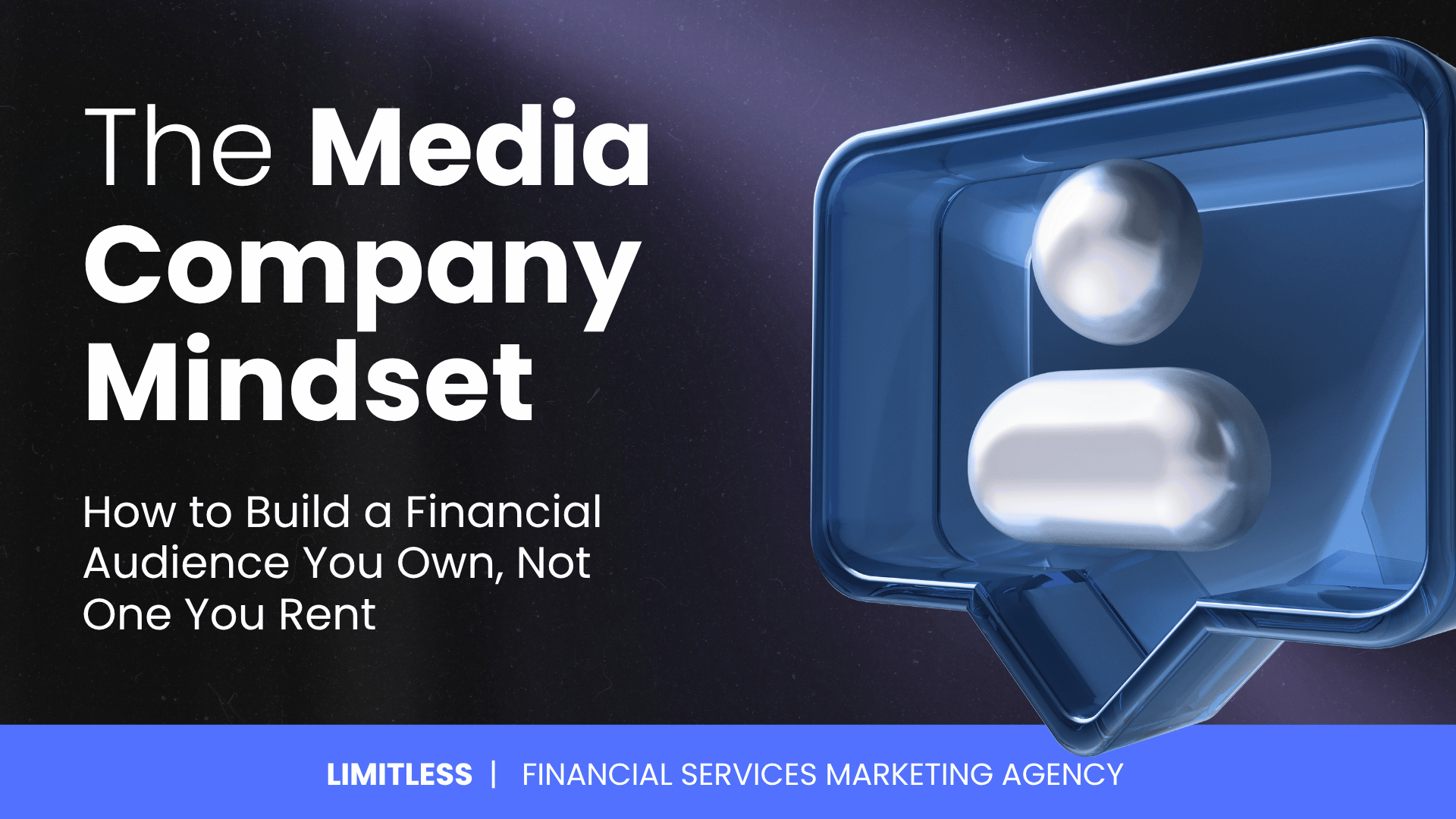
The Media Company Mindset: How to Build a Financial Audience You Own, Not One You Rent

Stop paying to talk to your own customers.
The old playbook of renting attention from social platforms is broken. Your financial brand’s most valuable asset is an audience you own. It’s time to stop being a guest on other platforms and start building your own.
- 🎯 Ditch the “Campaign” Mindset: Start thinking like an Executive Producer. Your job isn’t to run ads; it’s to create a flagship “show” so good, people would pay for it (but you give it away for free).
- ⚡ Weaponize the “Atomization” Play: One amazing webinar or podcast isn’t one asset. It’s 20. Turn it into short-form videos for social, SEO-optimized articles, quote graphics, and email-exclusive insights. Maximize everything.
- 🚀 Build Your “Owned” Channels First: Your email list and your website are the only two platforms you truly control. Every social post, every ad, should have one goal: moving people from rented ground to your home turf.
- 💰 Master the LTV:CAC Connection: An owned audience has a 10x higher Lifetime Value (LTV) and a near-zero Customer Acquisition Cost (CAC) for all future campaigns. You’re not just building a list; you’re building a profit-generating machine.
- 🤝 Shift from “Sales” to “Authority”: The best media companies don’t sell; they educate. By becoming the definitive, trusted source in your niche, the sales become a natural byproduct of your authority and the trust you’ve built.
Let’s be brutally honest for a minute. You, as a financial marketer, have been lied to.
You’ve been told the game is about “impressions,” “reach,” and “engagement.” You’ve been sold a playbook that says if you just shout loud enough on enough social platforms and pour enough money into paid ads, you’ll win.
Here’s the hard truth: that playbook is a trap. It’s a game rigged against you, and it’s designed to keep you paying rent forever.
Think about it. Your multi-million dollar ad budget on a social platform? That’s just rent. Your massive following on LinkedIn or Instagram? That’s a rented audience. At any moment, an algorithm change can (and will) wipe out your organic reach. A platform can (and will) increase your ad costs. You don’t own that relationship. You’re just a tenant, and the landlord just raised the rent—again.
I see it every day: financial firms, from global banks to nimble fintech startups, building their entire growth strategy on “rented ground.” They are completely at the mercy of platform algorithms they don’t control and rising ad costs that are crushing their margins.
There is a better way. It’s a fundamental shift in philosophy. It’s the difference between being a street-corner advertiser and being a broadcast network.
It’s time to stop thinking like a financial marketer and start thinking like a media company.
The Great Lie: Why “Rented Ground” Is a Business-Killer
“Rented ground” is any platform where you don’t own the audience or the rules. This includes:
- Social media platforms (Meta, LinkedIn, X, TikTok)
- Paid advertising (Google Ads, Facebook Ads)
- Third-party media (placing an article in a major publication)
For years, this was the only game in town, and it worked. But the ground has shifted beneath our feet. Relying on rented media in 2025 is no longer just inefficient; it’s a critical business risk.
Risk 1: The Algorithm is Your Unseen, Uncaring Boss
You spent years building a following of 100,000 people on a social platform. You post an important update… and 2% of them see it. Why? The algorithm decided it wasn’t “engaging” enough. To reach the other 98,000 people who already asked to follow you, you have to pay. You are paying, literally, to talk to your own fans. It’s digital extortion, and we’ve just accepted it as “the cost of doing business.”
Risk 2: Your Customer Acquisition Cost (CAC) Is a Runaway Train
As more brands flock to paid platforms, the ad auction becomes more crowded. What happens in a crowded auction? Prices go up. Your Customer Acquisition Cost (CAC) is on a one-way trip to the moon, and it’s eating your profits alive. You are stuck in a hamster wheel, forced to spend more and more money just to get the same number of leads you got last year.
Risk 3: You Have No Direct Relationship
What do you really have on a social platform? A list of “followers.” You don’t have their email address. You don’t have their phone number. You can’t segment them by their real interests (e.g., “interested in retirement planning” vs. “interested in first-time home buying”). You have a proxy for a relationship, managed by a middle-man whose only goal is to sell ads, not to help you build trust.
When you build your brand on rented ground, you are building a castle of sand. The tide is coming in.
The “Owned” Asset: What Are We Actually Building?
The “Media Company Mindset” is the strategic decision to build your own platform and your own audience.
“Owned media” refers to the channels that you, the brand, control 100%.
- Your Website & Blog: This is your home base. Your digital flagship store.
- Your Email List: This is your single most valuable asset. It’s a direct, one-to-one line of communication to thousands of people who asked to hear from you.
- Your Podcast / Video Series: A “flagship show” that creates a deep, habitual relationship with your audience.
- Your Community: A private forum, Discord server, or group where your best clients can talk to each other.
The benefits are game-changing.
- Direct, Unfiltered Access: When you send an email, there is no algorithm deciding if it gets seen. You have a direct line to your audience’s inbox.
- Zero-Cost Communication: Once you’ve built a list of 50,000 email subscribers, launching a new product or webinar costs you $0 in ad spend. The ROI is infinite.
- Deep Data & Personalization: You own the data. You can track what articles they read, what webinars they attend, and what links they click. This allows you to segment your audience with surgical precision and deliver hyper-relevant content that builds trust, not a generic “newsletter” that gets ignored.
- A Defensible Moat: Your competitors can copy your product features. They can bid on the same keywords. They cannot copy your relationship with your audience. An owned audience is the only truly defensible competitive advantage in the modern financial market.
> Also Read: Venture Capital Marketing 2025
Phase 1: Finding Your “Show” — The Content Strategy
Okay, so you’re ready to become a media company. Your first question isn’t “What do we post?” It’s “What show are we creating?”
A media company doesn’t just “make content.” It creates a specific, branded show with a reliable, predictable point of view.
1. Define Your Niche, Then Go Deeper
You can’t be the media company for “all things finance.” It’s too broad. You’ll be competing with CNBC and Bloomberg. You have to find your niche.
- Bad Niche: “Investing”
- Good Niche: “Retirement planning for freelance creatives”
- Excellent Niche: “Helping tech-industry pre-retirees navigate the tax implications of their stock options”
See the difference? The “excellent” niche is hyper-specific. You can become the #1 authority in the world on that one topic. The audience is smaller, but they are 100x more qualified and valuable.
2. Identify Your “Magic Wand” Problem
Go beyond demographics and “Jobs-to-be-Done.” Ask yourself: If I could wave a magic wand and solve the single biggest, most annoying problem my audience faces, what would it be?
For a wealth manager, the “product” is a portfolio. But the “problem” isn’t a lack of a portfolio. The problem is anxiety. The problem is the fear of making a mistake. The problem is the confusion of conflicting advice.
Your “show” shouldn’t be “How to Invest.” It should be “The Financial Peace of Mind Show.” Your content isn’t about what you sell; it’s about why it matters.
3. Choose Your “Flagship” Format
You don’t have to be everywhere. You have to be amazing in one place. Choose one “flagship” format and commit to it.
- The Flagship Podcast: A weekly show with your best market analysts or advisors. (Example: Morgan Stanley’s “Thoughts on the Market”). This is great for building human connection and authority.
- The Flagship Video Series: A high-production, educational YouTube series that breaks down complex financial topics. (Example: A fintech app creating the “Financial Fitness in 5 Minutes” show).
- The Flagship Newsletter: This is my personal favorite. A high-value, insights-driven email that becomes a must-read for your audience. Not a sales pitch. Not a “roundup” of your blog posts. A piece of original, high-value analysis they can’t get anywhere else.
Your flagship is your stake in the ground. It’s your promise to your audience.
Phase 2: Building the “Studio” — The Content Engine
Once you have your “show,” you need to build the “studio”—the system that allows you to produce high-quality content consistently, at scale, without burning out your team.
This is where most financial firms fail. They treat content like a project. A media company treats it like a process.
The “Pillar & Cluster” Playbook
Your blog can’t be a random collection of thoughts. It must be an organized library, and the “Pillar & Cluster” model is the blueprint.
- Create a “Pillar” Page: This is a massive, 5,000+ word “Ultimate Guide” on a broad, high-value topic in your niche. (e.g., “The Ultimate Guide to Estate Planning”). This page is designed to be the single best, most comprehensive resource on this topic on the entire internet.
- Create “Cluster” Content: These are 15-20 smaller articles on specific, long-tail-keyword sub-topics. (e.g., “What is a Living Trust?”, “How to Choose an Executor,” “Estate Tax vs. Inheritance Tax”).
- Link Everything: Every single “cluster” article links back to your main “pillar” page. This signals to Google that your pillar page is the central authority on the topic, and it funnels all your traffic to one high-converting asset. You are no longer just ranking for keywords; you are owning an entire topic.
The “Content Atomization” Flywheel
This is the secret to 10x’ing your ROI. Never, ever, ever create a “one-and-done” piece of content.
A media company understands that one high-effort asset is a goldmine. You must “atomize” it.
Let’s say you host one (1) 60-minute webinar with a top advisor. That one asset becomes:
- 1 Long-Form Video: The full webinar on YouTube for SEO.
- 1 Audio-Only File: The .mp3 version for your “flagship” podcast.
- 1 SEO-Optimized Article: A 2,000-word blog post based on the webinar’s transcription.
- 5-7 Short-Form Videos: The best 30-60 second “nuggets” of wisdom, formatted for TikTok, Reels, and YouTube Shorts.
- 10-15 Quote Graphics: The most powerful quotes, turned into beautiful graphics for LinkedIn and Instagram.
- 1 Twitter/X Thread: A 10-part thread breaking down the key takeaways.
- 1 Email-Exclusive Asset: A “bonus” checklist or PDF from the webinar, available only to your email subscribers.
You didn’t create 20 pieces of content. You created one and then repurposed it 20 times. This is how you build a high-velocity production engine.
> Also Read: Forex Broker Marketing Plan 2025
Phase 3: The “Distribution” Network — From Rented to Owned
This is a critical point. I am not saying you should delete your social media accounts. That would be foolish.
A media company still uses “rented” channels. But it uses them differently.
Rented media is not the destination. It is the bridge.
The only job of your social media posts, your paid ads, and your LinkedIn articles is to get a person to take one action: move from rented ground to owned ground.
- Your LinkedIn post shouldn’t just ask for a “like.” It should offer a high-value report in exchange for an email.
- Your TikTok video shouldn’t just be entertaining. It should have a clear call-to-action to “Get the full guide in our bio link,” which leads to a landing page.
- Your paid ad shouldn’t just sell your product. It should promote your free “5-Day Financial Fitness Challenge”—which is delivered via email.
You are using the rented platforms’ own algorithms to poach their users and bring them into your ecosystem. Every email you capture is a permanent, valuable asset you just pulled from a temporary, rented platform.
Phase 4: Monetizing the Audience (Without Selling Your Soul)
This is the most important part for a financial brand. You’ve spent months, maybe years, building a loyal audience of 100,000 people who trust you. They read your emails. They listen to your podcast.
The fastest way to destroy all that trust is to pivot and slam them with a hard sales pitch.
A media company understands that the audience is the asset. Your job is to nurture, not to pitch. The “sale” should be the most natural, logical next step in the value-driven relationship you’ve already built.
1. The 90/10 Value-to-Pitch Ratio
For every 10 “touches” you have with your audience, 9 of them must be 100% pure value. No pitch. No CTA to “book a call.” Just insanely good, valuable, helpful content that solves their problems.
The 10th touch can be the “offer.” When you’ve delivered that much value upfront, you’ve earned the right to ask. This builds on the psychological principle of Reciprocity. Your audience will want to repay you for all the free value you’ve given them.
2. Segment and Guide, Don’t Batch and Blast
Never send a mortgage offer to a 22-year-old on your list who has only read your articles on “how to start investing.” It’s lazy, and it breaks trust.
Use your data. Segment your list based on behavior.
- Segment A: People who have only read “beginner” investing articles.
- Nurture: Send them an invitation to your “Intro to Investing” webinar.
- Segment B: People who have read three different articles on “retirement planning.”
- Nurture: Send them a link to your “Retirement Calculator” tool.
- Segment C: People who used the calculator and attended the webinar.
- Nurture: This is the person who gets a soft, personalized offer: “You seem serious about your retirement. Would you be open to a 15-minute, no-obligation chat to review your calculator results?”
You’re not selling. You’re guiding them to the solution they’ve already told you they’re looking for.
> Also Read: Financial Services Marketing Strategy
Conclusion: Your New Job Title is “Editor-in-Chief”
The shift to a “Media Company Mindset” is not a small marketing tactic. It’s a fundamental change in your entire business philosophy.
It’s an admission that your customers don’t want to be “marketed to.” They want to be educated, informed, and even entertained. They are drowning in a sea of noise and are desperate for a trusted, authoritative voice to guide them.
Your brand can be that voice.
But it requires a new commitment. It means your “Head of Marketing” is now your “Editor-in-Chief.” Your “Content Creators” are your “Reporters and Producers.” Your “Brand” is your “Publication.”
Stop building your business on rented land. Stop paying fees to a landlord who doesn’t care about you.
Start the hard, rewarding work of building your own platform. Lay the foundation, build the walls, and open the doors. Build an asset that no one can ever take away from you. Build an audience you own.
Sources:
- https://school-education.ec.europa.eu/en/learn/courses/educational-marketing
- https://www.highereducationdigest.com/the-importance-of-marketing-education-in-marketing-and-entrepreneurship/
- https://www.marketinglevels.com/
- https://web.berlinsbi.com/msc-digital-marketing-uca?utm_source=google&medium=ppc&utm_campaign=b:bsbi-ber-p:msc-digital-marketing-pg-o:cv-c:search-g:me-tr-l:en&utm_term=masters%20in%20digital%20marketing&creative=751339162991&network=g&device=c&placement=&adposition=&cq_src=google_ads&cq_cmp=17743773494&cq_term=masters%20in%20digital%20marketing&cq_con=178047089006&cq_med=&cq_plac=&cq_net=g&gad_source=1&gad_campaignid=17743773494&gbraid=0AAAAADCV97ucv7n1aiczLhPEykgyp1M2s&gclid=CjwKCAiAzrbIBhA3EiwAUBaUdUkYuN1RficsUH3lVA3rgpZGPgbwGkXXgeNPtmqygRAgIAh–PDOKhoCYTEQAvD_BwE